
By Lee Wochner
Artificial intelligence is changing nonprofit marketing
If you’ve noticed a shift, you’re not wrong.
Maybe your website traffic is softer than it used to be. Maybe your email open rates have dipped. Maybe a donor mentioned they found you through an AI tool, and you thought: Huh. That’s new.
It is new. And it’s big.
The shift in nonprofit marketing strategy
Artificial intelligence is reshaping how people find information, how they make decisions, and ultimately how they find your organization. After nearly two decades of working with nonprofits on their marketing, I’ve watched a lot of shifts. This one is as significant as any of them.
Here’s what’s actually happening, and what you can do about it.

Zero-click search is changing how nonprofits get found
For years, nonprofit digital strategy centered on search. Get to the top of Google, get found, get donors. That logic hasn’t disappeared entirely, but the game has changed in a fundamental way.
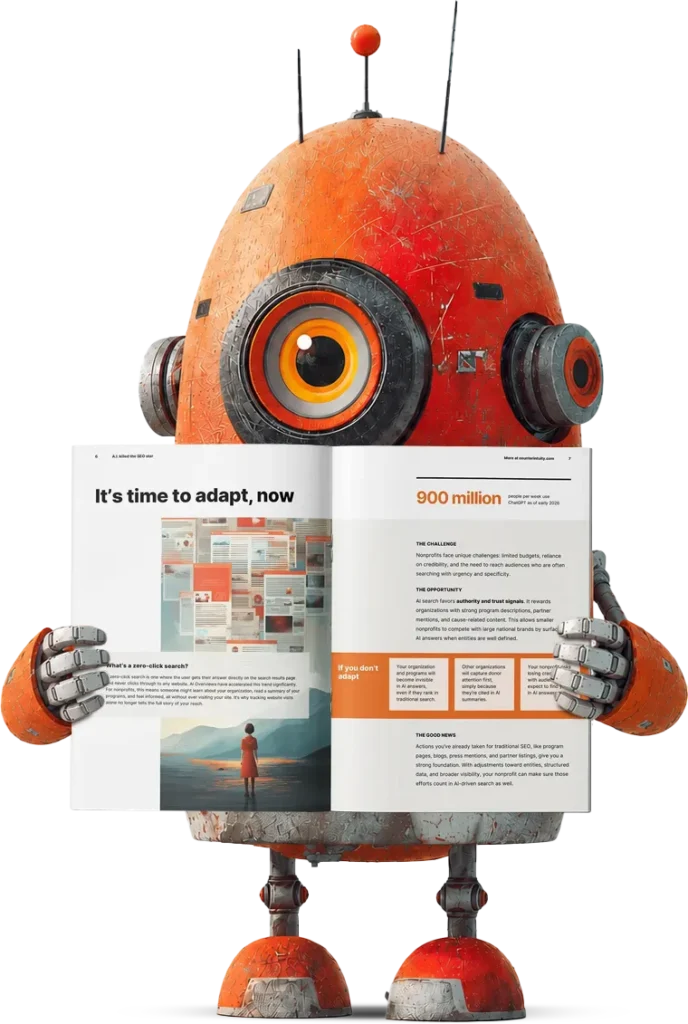
We’ve entered what marketers call the zero-click search environment. With the rise of AI search, when someone searches for information on Google, they increasingly get the answer directly on the search results page, generated by AI, without ever clicking through to a website. Google does the research for them.
Think about what that means for your organization. You’ve invested in your website, your content, your search engine optimization. And now a significant percentage of people searching for something directly relevant to your mission never arrive at your site. They got what they needed before they got to you.
Traffic from Google is down across the board for content-driven sites. Nonprofits, which have historically relied on organic search, are feeling it.
Here’s what to do:
Stop measuring success by traffic alone. Shift your focus from getting clicks to being the answer. Create clear, credible content that AI can easily understand, trust, and surface. Structure your messaging so it stands on its own. And build direct connections through social, partnerships, and earned media (news stories/PR), so your audience doesn’t have to find you through search in the first place.
Is your nonprofit showing up when donors search with AI tools?
AI search tools like ChatGPT, Perplexity, and Google AI Overviews are changing how people find organizations like yours. The nonprofits that get cited are the ones that have built the right foundation.
Take a free two-minute assessment and get a personalized action plan.

Is the Google Ad Grant for nonprofits still worth it?
A lot of nonprofits have leaned heavily on the Google Ad Grant, the $10,000 per month in free search advertising available to eligible organizations. It has been an extraordinary tool, and it remains valuable. We manage the grant for a number of nonprofits, and we see real results.
But is it as powerful as it was a few years ago? No. Because of AI search and the zero-click shift, grant-funded ads are getting fewer clicks than they once did.
Here’s what to do:
Use it anyway. Here’s the reasoning: Even with reduced click-through rates, the Google Ad Grant costs you nothing in terms of ad spend. And with the minimal investment needed to manage the campaign, it’s still a good deal. The key is to recalibrate your expectations to fit today’s environment, not the environment of a few years ago, and to treat the grant as one tool in a broader strategy rather than the foundation of your digital presence.
Nonprofits using Google Ads get a faster feedback loop. You can test messaging against real search behavior and see what earns attention before committing to full content. That kind of early signal is harder to get from analytics or social alone.
How AI is changing search, email, and social for nonprofits
Search is only part of the picture. AI is changing the environment your donors and constituents live in at every level.
Social media algorithms are now deeply AI-driven. What gets seen (and what doesn’t) is no longer just about timing or hashtags. AI systems constantly read engagement patterns, content quality markers, and user behavior.
Email is being filtered through AI inboxes. Your carefully written donor communications are being triaged by AI before a human ever reads them. That changes what works.
And your donors are using AI tools themselves. They’re asking ChatGPT, Perplexity, Claude, and Gemini questions like “What’s a good nonprofit to support for climate action?” or “How do I find a reputable food bank in my city?”
All of this is changing how donors discover and evaluate nonprofits. How does your organization show up in those conversations?
The shift from traffic to trust in nonprofit marketing
For years, the goal of nonprofit marketing was often framed as: Get people to your website. Get traffic. Get eyeballs. In the AI era, the goal has changed.
The new goal is to become the answer. Not just to rank for a keyword, but to be so clearly and credibly associated with your mission that when an AI system, a search engine, or a fellow donor is asked about your cause, your organization comes up.
This is actually good news for nonprofits.
What builds that kind of presence? Trust. Specificity. Real stories. Genuine community relationships. Deep expertise in your mission area. Nonprofits doing good work often have them in abundance. You just need to surface them differently.

Five nonprofit marketing strategies to use in the AI era
- Invest in depth over volume. Stop trying to publish as much content as possible. AI can produce volume infinitely. What it cannot produce is your lived experience, your specific community knowledge, your on-the-ground stories. One deeply reported, story-rich piece about what your work actually looks like in your community is worth dozens of generic posts.
- Build your email list like your life depends on it. Your email list is the one channel AI has not taken over. It’s yours. The algorithm doesn’t control it. If you have a healthy, engaged list, you have a direct line to people who have raised their hand and said they want to hear from you. That is extraordinarily valuable right now.
- Get specific about who you serve and where. Nonprofits have a structural advantage over large organizations: You are local, or you are hyper-specific in your mission. Lean into that. Local SEO, neighborhood-level storytelling, and hyper-specific content are areas where you can win. Specificity is a superpower in the AI era.
- Become an authoritative voice in your space. When AI systems answer questions about your cause area, they draw from what’s credible, cited, and established. Get yourself and key authoritative voices in your organization quoted. Get linked to. Publish your data. Write op-eds. Be the expert voice in your mission area. This is long-game work, but it compounds.
- Use AI as a tool, not a threat. Sure, AI is disrupting marketing on every level, but AI can also help you market more effectively. Use it to brainstorm content ideas, draft donor communications, analyze your data, and repurpose long content into social posts and email snippets. The nonprofits that will thrive are the ones that use AI as a force multiplier for their human team. Just make sure you stay in control of the thinking. AI can help you move faster, but strategy, clarity, direction, and meaning have to come from your team.
Your mission is your advantage in the AI era
This is the new reality of nonprofit marketing in the AI era. Organizations with real missions, real community trust, and real human stories are going to be more valuable in the AI era, not less. Authenticity is increasingly scarce. Genuine expertise is what AI systems are trying to surface. People are hungry for real relationships with causes they actually believe in.
Your mission is your competitive advantage. Your community is your competitive advantage. Your story is your competitive advantage. The tools and tactics will keep changing. Those things won’t.
Common questions about AI and nonprofit marketing
How is AI changing nonprofit marketing?
AI is changing how people find, evaluate, and engage with nonprofits. Search engines now provide direct answers without clicks, email platforms filter messages using AI, and donors increasingly use AI tools to research organizations. This shifts the focus from driving traffic to building trust and visibility across multiple channels.
What is zero-click search, and why does it matter for nonprofits?
Zero-click search refers to search results where users get their answer directly on the results page without visiting a website. For nonprofits, this means fewer website visits and more competition to be included in the answers people see. Clear, credible, and well-structured content increases the chances of being surfaced.
Is the Google Ad Grant still worth it for nonprofits?
Yes. While click-through rates may be lower than in the past, the Google Ad Grant still provides free visibility in high-intent search moments. It also offers a fast way to test messaging and understand how people search, which can improve broader marketing efforts.
How can nonprofits show up in AI tools like ChatGPT?
Nonprofits show up in AI-generated answers by building credibility and authority. This includes publishing clear and specific content, earning mentions and links from trusted sources, and consistently demonstrating expertise in a defined mission area.
What should nonprofits focus on instead of website traffic?
Nonprofits should focus on trust, clarity, and visibility across channels. This includes building direct relationships through email, strengthening presence on social platforms, earning media coverage, and creating content that can stand on its own in search and AI-generated results.
How can nonprofits use AI in their marketing?
AI can help nonprofits brainstorm ideas, draft content, analyze data, and repurpose materials across channels. A nonprofit’s most effective use of AI is as a support tool, speeding up execution while keeping strategy, messaging, and decision-making in human hands.
What you need to know about AI and nonprofit marketing
Lee Wochner explains how AI is changing nonprofit marketing and shares practical steps nonprofits can take right now.

Lee Wochner is CEO and Creative Strategist at Counterintuity. For more than 25 years, he has helped nonprofits and mission-driven organizations find their story, sharpen their message, and reach the right audiences. As a founder and leader of organizations himself, he understands the realities behind the work and what it takes to move a mission forward.