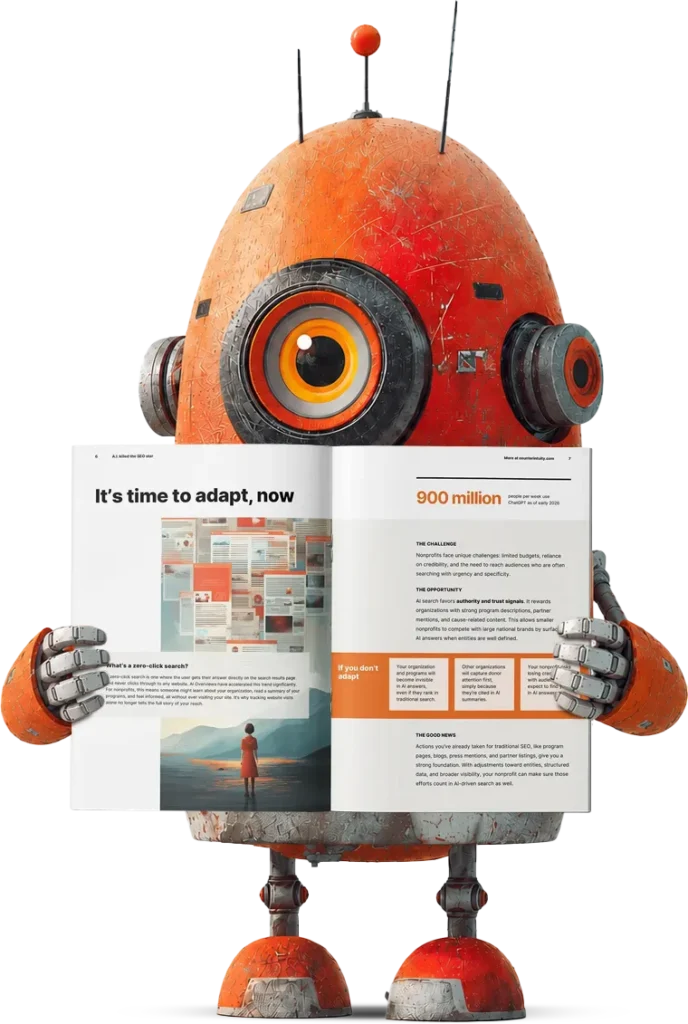
Nonprofit marketing has fundamentally changed, and AI is at the center of it. Search works differently now. Email faces new filters. Donors are discovering organizations through AI tools that most nonprofits aren’t even thinking about yet.
Counterintuity CEO and Creative Strategist Lee Wochner cuts through the noise to explain what’s actually happening in nonprofit digital marketing and what you can do about it right now. He covers the rise of zero-click search and what it means for your website traffic, the honest state of the Google Ad Grant, how AI is reshaping nonprofit email marketing and social media, and five practical tactics any nonprofit can act on today.
The opportunity is real. Nonprofits with genuine missions, community trust, and authentic stories are well-positioned to thrive in the AI era. Lee walks you through how to use what you already have.
Jaclyn Uloth: Welcome to How to Market Your Nonprofit, the Counterintuity podcast featuring interviews with experts in marketing, fundraising, strategy, and leadership who offer how-tos and inspiration about how you can help your nonprofit succeed and grow during a time of chaos and change. Bringing his 25 plus years of experience in marketing, strategy, and nonprofit management, here’s our host, Lee Wochner.
Lee Wochner: Welcome to another episode of How to Market Your Nonprofit. And I’m really glad you’re here today and every time you tune in, because we are committed to helping nonprofits succeed in their mission. And we’re always happy to share what we know to help with the marketing and even management aspects of that. We’re now in our 19th year of proudly supporting nonprofits. And I have to tell you when you’re working with nonprofit leaders, people working every day to make a positive impact on people’s lives, it is very fulfilling work indeed. And we know that things have changed dramatically over the past five or six years or seven, dramatically indeed. And we know that things have changed dramatically over the past five or six years, dramatically indeed.
And that’s something we’ve been talking about and also hearing about from nonprofit leaders doing the work. Boy, it is not like it was in 2019, not socioeconomically, not politically, and not technologically. If you view those changes like a crisis, I understand some of it does represent a crisis. But what I know about crisis is also this.
Every crisis creates opportunity. So today, I want to talk with you about the opportunity of how nonprofit marketing has changed. Because yes, nonprofit marketing has changed, has changed, and will change. The world of nonprofit marketing has changed not just a little bit, fundamentally. And AI is at the center of that shift.
Now, I know when people hear AI and marketing, they might expect a hype fest. That’s not what this is. Today, as always, I want to be honest with you about what’s actually happening, what the real implications are for nonprofits specifically, and most importantly, what you can do right now. Because here’s what I know about you, given all the work we do with nonprofits and all the nonprofit service I myself have done.
Lee Wochner: You don’t have time for theory. You’ve got a mission to run, a team to lead, donors to steward, and probably 12 things on your list right now. So we’re going to do our best to make this useful. And that’s always our goal. So OK, so let’s dig in. And let’s start with how the ground has shifted. So.
The big picture is we have dramatic changes that may not have been noticeable at first. So they sneak up on you. You notice the traffic to your website is a little softer. Your email open rates aren’t quite what they were. A donor says they found you through a conversation with their phone. And you think, hmm, something’s different.
Well, that something is artificial intelligence and it’s reshaping how people find information, how they make decisions and ultimately how they find you. So what’s actually changed is the zero click universe. And I’m going to explain that. Let’s talk about Google first because this one is big. For years, nonprofits have built their digital strategies around search. Get to the top of Google, get found.
get donors. And that logic still exists, but the way that plays out has changed dramatically. We’ve entered what people in the marketing world call the zero click universe. And if you spend any time with me in person, I warn you, I may go on tedious length about the zero click universe. Here’s what that means. When someone types a question into Google Now, increasingly, they get the answer right there on the search results page.
Nobody had to click anywhere. It came right up. And think about it. Think about the last search you put into Google on a screen. Let’s say you were at your desktop and you put it in there and then this preview, what looks like a preview popped up. It’s AI generated. It gave you the answer and you didn’t go any further. Google powered by AI just tells you what you need to know immediately. So think about that. You’ve worked hard on your website, your content.
Lee Wochner: your search engine optimization, and now a huge percentage of people who search for something relevant to your message never actually arrive at your site. They got what they needed before they even got to you. Google traffic is down across the board for content-driven sites, and nonprofits who have historically relied on organic search are feeling it. Now, you know, that’s troubling.
I don’t want you to panic. In fact, I don’t want you to panic about anything going on in the world right now. We work on what we can work on to make a positive difference, and we just keep moving forward. And we keep making positive impacts, so no panic. Panic isn’t helpful about anything. But I do want you to understand this Google situation clearly because it affects decisions you’re making right now. And one of them, of course, is going to be related to Google Grant.
Lee Wochner: So a lot of nonprofits have leaned heavily on the Google Ad Grant at that $10,000 a month in free search advertising. And it has been an incredible tool. For years, it was essentially free visibility. Someone searches Food Bank Near Me or How to Support Veterans, and your nonprofit shows up at the top. And it’s still valuable. We managed the Google Ad Grant for a number of nonprofits, and we see the results.
If you don’t already have a Google ad grant, you should get one and we can help you do that if you need help. But is it as powerful as it was four years ago? No. Because of AI search and the zero click shift into the zero click universe, the ads that show up through grant funded campaigns are getting fewer clicks than they did even two or three years ago. The intent is still there, but the behavior has shifted.
But, and this is important, use it anyway. Seriously, use it anyway. And here’s why. Even in a world of reduced click-through rates, the Google Ad Grant is still free. If you’re eligible and you’re not using it, you are leaving money and visibility on the table. The returns may be lower than they once were, but with zero investment, i.e. it costing you nothing,
Zero investment for any return is still a good deal. And by the way, this is why we pursue a long tail strategy. We’re going after little minor clicks can often turn into big rewards. And if you Google, ironically, if you Google long-term strategy, you’ll see what I’m talking about. I’ve addressed it before here on this podcast. The key here with the Google Ad Grant is to recalibrate your expectations.
Don’t measure it the way you did in 2019. As I tell everybody under the sun, 2019 isn’t coming back. It’s gone. We’re in a new age. There is no return to normal, whatever normal is or was. We have to recognize that 2026 is its own environment, its own situation. So recalibrate your Google Ad Grant expectations to fit with 2026 when some of the traffic it used to result in
Lee Wochner: now goes through AI into the zero click window. Manage your expectations in context of today’s environment and pair it with a broader strategy, which we’re going to get to in just a minute. The grant is a tool, the Google Ad Grant. It should be part of your toolkit and not the foundation of your digital strategy. So let’s talk about what else is affecting your marketing. And it’s not just Google. I want to zoom out for a second because AI is changing more than search. It’s changing the entire information ecosystem your donors and constituents live in. Social media algorithms are now deeply AI driven. What content gets seen and what doesn’t is no longer just about timing or hashtags.
And we did have a recent episode with Jacqueline Uloth talking about the death of the hashtag, for example. So you might check out that episode. So now it’s about more than that. It’s about signals that AI systems are reading constantly. Engagement velocity, content quality markers, user behavior patterns, other terms like that. Email marketing is being filtered through AI inboxes, Gmail’s smart categories.
apples, mail summarization. Your carefully written emails are being triaged by AI before a human ever reads them. That changes what works. And your donors, they’re using AI tools themselves, ChatGPT, Perplexity, Clawed, Gemini. There are dozens, hundreds more to choose from. They’re asking these tools questions like, what’s a good nonprofit to donate to for climate change?
Or how do I find a reputable food bank in my city? How does your organization show up in those conversations? And so part of what I’m saying here is you want to be part of the conversation and that conversation can take place on your blogs, in your podcasts, in any sort of appearance that you use. And by the way, I’ll tell you a little test that was run when, when AI samples content.
that’s written by AI, it performs badly. So imagine that you’re making a Xerox. Remember Xerox copying? We still use a little bit of that now and then, right paper. If you copy a copy of a copy, the image degrades. AI sampling content written by AI and using it in AI results gets worse and worse and more and more wrong. And so what happens is,
Lee Wochner: AI algorithms wait toward trusted communications. so podcasts, for instance, are very highly ranked. If you appear on a podcast and you’re talking about the things related to what your nonprofit does, you are more likely to come up and search. helping your authority because it’s a trusted source. It’s a person talking to a person. It’s not AI generated content.
This, by the way, is one of the reasons that counterintuity does not use AI-generated content. We may use AI for brainstorming, but for clients and for ourselves, we write our own content. So let’s talk about a few things, and let’s dig into the issues for a second, the issues and fears. What are nonprofit leaders worried about right now with their marketing? So there are a few fears coming up again and again.
And one of them is donor fatigue combined with more competition for attention. There are more messages, more causes, more asks, and AI is enabling everyone to produce more content than ever. The noise is getting louder and not all of that content is good. And I’ll tell you the endless AI generated historical fact or factoid story about something in music history that seems to be like three pages long. That’s a post I see.
constantly on Facebook, I find it kind of irritating. There’s nothing genuine in it. So we’re concerned about fatiguing people with too many messages and long messages. And we’re going to get to the solution of that for you in a minute. then nonprofit leaders are concerned about losing ground on search engine optimization they worked hard to build. If Google isn’t sending traffic the way it used to, what was all that content work for? People also.
talk to me about the speed of change, understandably, by the time they understand one shift, something else has changed. It feels like running on a treadmill that keeps speeding up. And I hear that these concerns are legitimate. But here’s what I wanna offer you. I wanna offer you a frame that I hope helps. And that is, and you already heard me prefacing it, the shift from traffic to trust.
Lee Wochner: So for years, the goal of nonprofit marketing was often framed as get people to your website, get eyeballs, get traffic. That was the top of the funnel. And from there, you’d nurture them toward giving. And that is not over. That to some degree continues to pertain. In the new AI era, the new goal is become the answer. Not just rank for a keyword, become so clearly, credibly, deeply associated with your mission.
that when an AI system, a search engine, or a fellow donor is asked about your cause, your organization comes up. This is actually great news for nonprofits because you know what builds that kind of presence? Trust, specificity, real stories, genuine community relationships.
Deep expertise in your mission area, profiles of people and causes where you made a real difference. In other words, all of those things that are clearly human, that are in your wheelhouse of what you do and that could not be written by a bot. Those things that I just listed are harder to fake than a keyword. And nonprofits, when they’re doing good work, have them in abundance. You have those stories. You just need to
bring them to light a little differently.
Lee Wochner: There’s a lot more to come here in this episode in terms of solutions to the changing environment, but we’re gonna take a short break here. When we come back, I’m gonna dig deeper into advice for you during this period of artificial intelligence opportunity. Note, I didn’t say overwhelm, opportunity and how that affects your marketing and much more. Stick around.
Jaclyn Uloth: According to the Association of Fundraising Professionals, the shelf life of a website is two years and seven months. So if your website is three years old or older, it probably needs a tune-up or a complete overhaul so that you can stay current and engaging. A website refresh provides design and content improvements to drive donations and new technology to save you on time. A website refresh provides design and content improvements to drive donations and new technology to save you time on tedious tasks while keeping your website safe from hackers. a free assessment of your website, contact us through our own website at counterintuity.com or email lee at lee@counterintuity.com. We’re ready to help. And now back to our show.
Lee Wochner: And we’re back with just me today talking about how artificial intelligence is changing marketing for nonprofits and how to take advantage of the new possibilities.
So let’s talk about what you can do right now. We’re gonna get tactical. And I want you to know that we’re already doing this for a number of people and we’re pursuing the same tactics here at Counterintuity and we know they’ll pay off because we see them pay off in practice. tactic number one, invest in depth over volume. If you’re trying to
publish as much content as possible, stop. That game is over. AI can produce volume infinitely. And by the way, this is a lot of work for you. So we’re giving you back some of your time. You don’t need a lot of volume. What AI cannot produce is depth, the depth of the human experience.
your lived experience, your specific community knowledge, your on-the-ground stories. One deeply researched, story-rich article about what hunger actually looks like in your area, told through a real family with real data written with your organization’s voice, is worth 50 generic blog posts. Google’s AI systems are increasingly good
at identifying genuine expertise. Give them something to work with. And I keep referencing Google because we’re talking about search, but you know, people use chat GPT, people use Claude to find solutions as well. You want to come up in those searches and the way you’re going to do that is by telling authentic stories of your experience. So invest in depth over volume. Tactic number two.
Lee Wochner: Build your email list like your life depends on it. Here’s the one channel that AI has not taken over, your direct relationship with your subscribers. Your email list is yours. The algorithm doesn’t control it. Social platforms don’t control it. Google doesn’t control it. And I’m always in favor of nonprofits holding on to the resources that they control to advance their mission.
So if you have a healthy, engaged email list, you have a direct line to people who’ve raised their hand and said, I want to hear from you. That is extraordinarily valuable right now. Invest in growing it and invest in what you send. I’m struck sometimes by nonprofits doing really valuable, meaningful work. And then when I ask them nicely, how often do you send out an email about what you do, an email newsletter, an alert?
Well, you we try to do that once a month. Whatever you can do to do this once a week is what I would strongly recommend. And again, building your list. Tactic number three, get specific about who you serve and where. This is a place where nonprofits actually have a structural advantage over large companies. You are local or you are hyper specific.
in your mission, lean into that. Local SEO, hyper-specific content, neighborhood-level storytelling, those are areas where you can win.
Lee Wochner: Food bank in Riverside County serving families with children under five is more findable, more relevant, and more trusted than a generic hunger relief keyword. So think about it. Food bank in Riverside County serving families with children under five. That’s pretty specific. That’s where you wanna be. In the AI era, specificity is a superpower.
Tactic number four, become an authoritative voice in your space. When AI systems are trained to answer questions about your cause area, what sources do they draw from? They draw from what’s credible, what’s cited, what’s been around, what’s been shared. So that means get quoted, get linked to, publish your data, share your research.
Get on podcasts like this one. Want to be a guest on our podcast? Let me know. Let’s have a conversation. Write op-eds. Be the expert voice. This is long game work, but it compounds just like interest. And it makes you visible not just in traditional search, but in AI-driven search and conversations. I’m struck by the number of nonprofit leaders we’ve had on our podcast who had never been on a podcast before. And good for them.
for taking the leap with us, you should be on podcasts. One of the things that I’ve discovered in working with nonprofit leaders for so long is that invariably you’re humble and I appreciate your humility. When it comes to telling your story and getting it out there, it’s essential. And so we don’t have to be braggy about what we’re doing, but we do have to get out there and be an authoritative voice.
and talk about what we do and how we do it and why it works and what the impact is. And that’s really what I’m talking about. And if you’re reluctant to do that at all, I want you to shoot me an email or contact me on LinkedIn because I’m gonna talk you into it. You have to do it. That’s where people are gonna find you and that’s why people are going to support you. And I know everybody listening to this is talking about their cause in some way. I’m just saying do a little more of it and do it through your marketing.
Lee Wochner: And then tactic number five, there’s so much fear about AI and I understand it’s not going anywhere. And so use AI as a tool, not a threat. So the irony is that AI is disrupting marketing, but AI can also help you market more effectively. Use it to brainstorm content ideas. That is one of the ways that we use it at
counterintuitively now and then. Other times, it’s just us in a meeting with our wits, which is a load of fun, I gotta tell you. But you know, when you generate some ideas, why not try them out in AI as well and see if it offers others that hadn’t occurred to you or your group. So use it for brainstorming. Use it to draft first versions of donor communications, perhaps. Again, you want to be writing finished product for all the reasons I already shared.
Use it to analyze your data and find patterns. I find it really useful that way. And I have to tell you, I use it to organize content, lots of facts and figure kind of stuff, because I’m not so great at organization in that way. And it’s been a help. And then if I’m using that data somehow rather in a report, in a communication, then I’m writing it. And use it to repurpose long content.
into social posts, email snippets, FAQ pages, then you rewrite it. Don’t just leave it in AI-generated final form. The nonprofits that are gonna thrive are the ones that treat AI as a force multiplier for their human team. Not something to fear, not something to blindly over-rely on, and for heaven’s sake, not something to replace humans with. We know we need humans here.
AI is a supplement. It’s like a super TV or a super typewriter. You use it for different things, but it’s not replacing people, not in our nonprofit work. Okay, so let me leave you with this. And this is the mindset that I really hope you carry forward because in my discussions with people working in nonprofits, I get a lot of FUD, fear, uncertainty, and doubt.
Lee Wochner: about AI.
and about the, particularly about the pace of change. So this pace of change is going to keep changing. It’s gonna keep changing. The speed of communication has radically changed the world and all the communities in the world. And we’ll continue to do so and we’ll just get faster.
So this is our 19th year in business at Counterintuity. And right from the start, we’ve been serving nonprofits. And here’s how right from the start, I would answer a client’s question about when will my website be finished? And I would say, never. I would say never because I wanted them to know that things were going to change and keep changing. Because your website will never be finished. we’ll launch it.
But your website is a living, breathing organism with new pages and new plugins and new content and new functionality all the time. All of it intended to help you tell your story and stay relevant and to be there when people need it. But finished? Never. And so that’s the message we’ve been putting out all along.
So it’ll be there and it’ll communicate your story just like you do and just like you have changed. You are not precisely the same person you were in 2019. Things have changed and you’ve changed as well. So that’s how we have to think about marketing. That’s how you have to think about your marketing and AI and everything we’re talking about today. It’s not going to slow down. It’s not going to be finished. It’s not going to come to a halt, period.
Lee Wochner: What I’ve described today is the landscape as it exists right now in this moment. And it will keep shifting. The organizations that are going to navigate this well are not the ones who find the perfect strategy today and execute it forever. In fact, the organizations we’ve seen that are troubled are trying to execute, excuse me, execute precisely as they did in a past time.
The ones who will succeed and continue to succeed are the ones who build cultures of learning and adaptation. So that means staying curious. It means following the developments, not obsessively, but consistently in technology and in our society and everything going on, setting aside time, maybe 30 minutes a week to learn what’s changing in digital marketing and artificial intelligence, connecting with peers,
who are wrestling with the same things. You don’t have to be an expert in AI. I’m not an expert in AI. I don’t even know if there are experts in AI, given how quickly it’s moving. But you have to be willing to keep learning and to give your team permission to experiment. And the moment that you are uncomfortable learning anything new, you have become a victim of what Alvin Toffler 50 years ago called future shock. Future shock is to be avoided
at all costs. So the opportunity is real here. The opportunity is real because here’s what I genuinely believe. The organizations with real mission, real community trust and real human stories are going to be more valuable in the AI era, not less, because authenticity is increasingly scarce. And I think we know that as more and more bots are doing whatever they’re doing in all of the
media coming across our eyes and ears. Genuine expertise from individuals is challenged in coming to the surface. Your opportunity is to help bring it to the surface. And I think you do have enormous opportunities to do that and great advantages because people are going to be hungry for real relationships with causes they actually believe in, managed by people.
Lee Wochner: who actually care and that they can connect with. And if you think about it, if you think about your daily interactions with people, you know that’s true. So your mission is your competitive advantage. Your community is your competitive advantage. Your story is your competitive advantage. The tools and the tactics will keep changing, but the others won’t. Your advantages will stay your advantages.
Lee Wochner: Okay, so there’s been a lot here these past 20 minutes. Let’s recap. So we covered a lot today. The zero click universe and what it means for your Google traffic. It’s changing, don’t sweat it, adapt. The Google ad grant, less powerful than it used to be, but you should use it anyway. The broader forces AI is having on search and social and email and donor behavior. Please note.
And the broader tactics, I shared a number of them that can actually move the needle for your organization right now.
The through line in all of this is this, lead with depth, not volume. Build direct relationships you own. Yes, use Facebook as an example to market yourself and your events, your organization, but get people to your website, get people onto your email list. Take control of the things you can control.
Be specific, be real, be the authoritative voice in your space. And use AI as a tool to amplify your human team, not to replace it. If this was useful to you, I hope you’ll share it with a colleague. And if you’ve got questions or you wanna go deeper on any of this, please reach out. I’d love to hear what you’re wrestling with. And I mean that sincerely. Every day, every single day,
Our team at Counterintuity and I are offering free advice to nonprofits. If you are struggling with a decision point, if your nonprofit feels in crisis, if you want some informed outside perspective, if you just need to be heard, I hope you’ll contact me. So many people have helped me in my life when I needed a shoulder to lean on or a strong mind to check in with that it feels only right to pay back into the pot. You can find me on LinkedIn.
Lee Wochner: And of course you can send me an email at lee at counterintuity.com Lee at counterintuity.com and I’ll be happy to see it and to respond. Don’t be shy. Drop me a line until next time. Keep doing the work that matters. You are changing lives every day. Those things that are going on now that feel terrible, those things in the world in, your life in
in our political, economic, sociological, technological sphere. Those things that feel terrible, upsetting, inevitable, they’re like the water rushing by in the river. They too will pass because change is constant and change is inevitable and a lot of change is positive.
Thank you for what you do and thanks for spending a little time with me here today. Much appreciated.
Jaclyn Uloth: Thanks for listening. How to Market Your Nonprofit is available on Apple Podcasts, Spotify, and wherever you get your podcasts. Please like and follow the show. Visit counterintuity.com to learn more.